
System
Composite Infrastructure Systems
One construction system: pultruded GRP profiles, gratings, AISI 316 mechanical connections and structural design. Five integrated components, from the choice of material to the life-cycle strategy.
The material
Seven properties.No treatment.
A unidirectional reinforced core, a biaxial wrap, a UV protective veil and a thermosetting resin matrix. The section is the material.
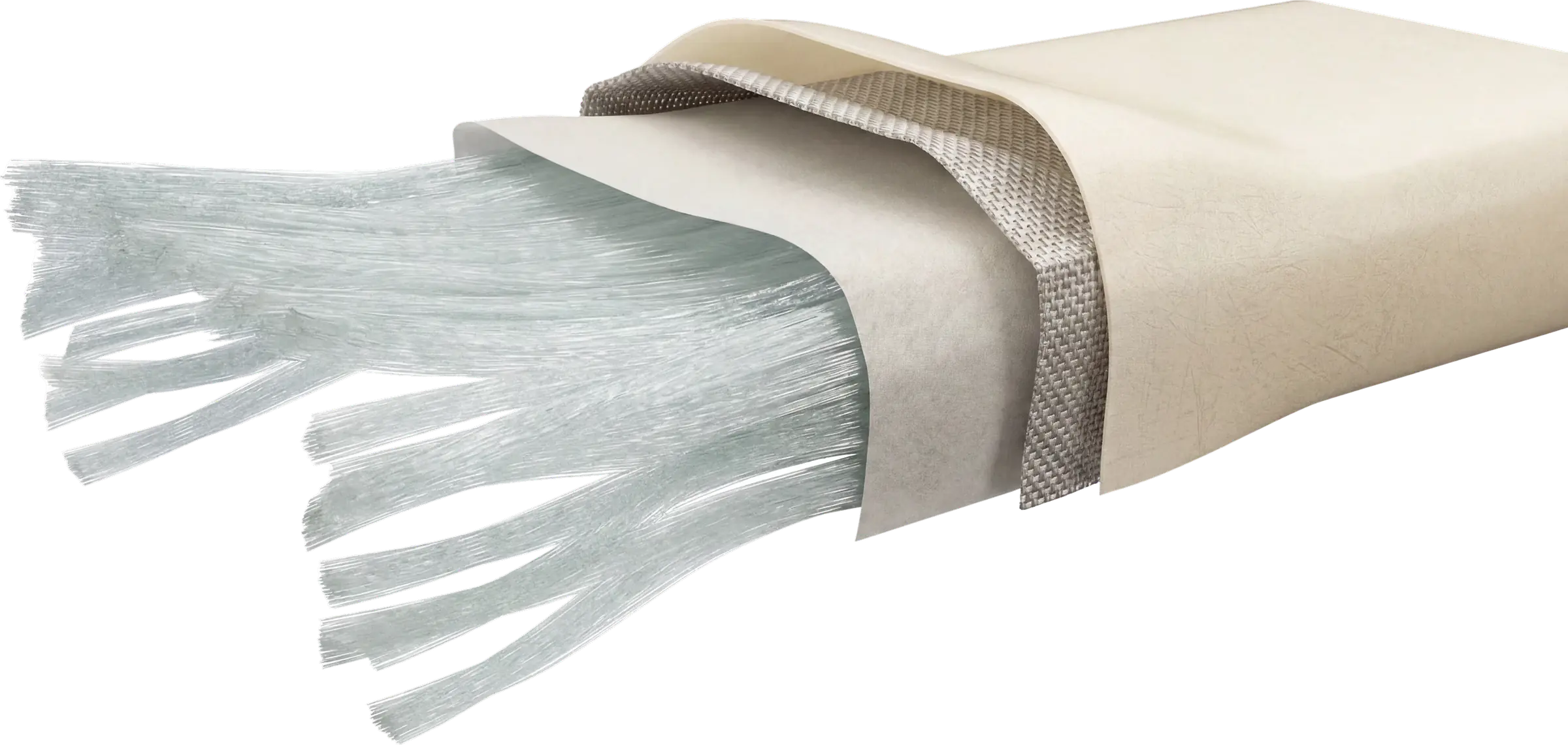
Core
Unidirectional reinforcement
Longitudinal strength optimised for axial and bending loads.
Wrap
Biaxial reinforcement
Transverse strength for dynamic loads and wave action.
Surface veil
UV resistant
Surface barrier against ageing under continuous weather exposure.
Matrix
Thermosetting resin
Inherently corrosion-free: no surface treatment to renew over the whole service life.
No corrosion
GRP does not oxidise: there is no protective treatment to apply or renew.
Mechanical strength
A better strength-to-weight ratio than structural steel for the same function.
Light weight
Around 75% less dense than steel: installed with light plant.
Electrical insulation
Dielectric by nature: no structural earthing required.
Chemical and thermal stability
Inert to acids, alkalis and salt; properties stable across the operating range.
Maintenance reduced to inspection
Management comes down to scheduled visual inspection: there is no protective treatment to renew.
Non-magnetic and radio-transparent
No interference with instrumentation: suitable for rail and electrical environments.
Anatomy of the system
Every component can be replaced.The system is permanent.
Modularity is not a compromise but a design decision: every element — from a single panel to the connections — can be inspected, checked and replaced without touching the load-bearing structure. That is why the life-cycle cost falls: not because the system is cheap to build, but because it never has to be demolished and built again.
01
GRP load-bearing structure
Pultruded GRP profiles: a better strength-to-weight ratio than steel, 75% less dense. Inert to chemicals, UV and oxidation.
> 340 MPa flexural strength
02
AISI 316 connections
AISI 316L stainless steel joints, immune to salt corrosion. Connections designed for 50 years of fatigue to CNR-DT 205/2007.
Nominal design working life 50 years — CNR-DT 205/2007
03
Walking surface
Anti-slip GRP structural gratings to UNI EN 13706 class E23. Panels replaceable one at a time; E60 fire resistance available on request.
UNI EN 13706 class E23
04
UV and chemical protection
Protection built into the production process, not applied to the surface afterwards. Chemical resistance from pH 2 to 12; no periodic maintenance required.
pH 2–12 chemical resistance
05
Optional sensing
Provision for strain, vibration and temperature sensors embedded in the composite. The structure measures its own condition.
BIM-ready, sensor-embedded
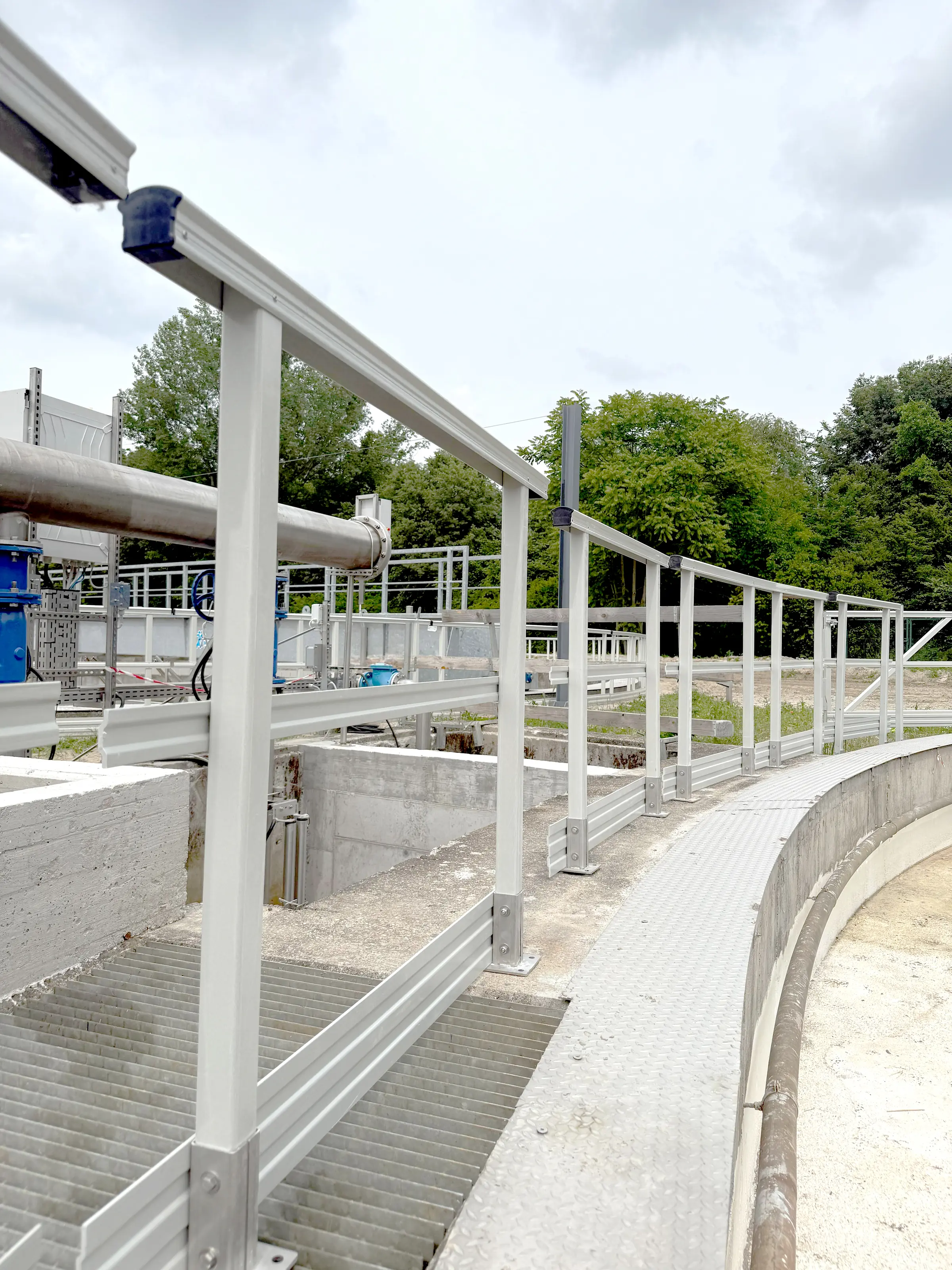
Structure, connections and walking surface in a single assembly
Life-cycle cost
The 50-year account, line by line.
Repainting, shutdowns, rebuilds: what steel asks for over time, GRP never puts on the account.
Traditional infrastructure
Composite Infrastructure Systems
Traditional infrastructure
Composite Infrastructure Systems
Codes and standards
CE marking, CAM, design codes.What we hold, what we apply.
The components are placed on the market with CE marking and a Declaration of Performance (EU Reg. 305/2011). The supply complies with the Italian minimum environmental criteria (CAM) for street furniture and for construction, evidenced criterion by criterion using each decree’s own verification means. Structural design follows CNR-DT 205/2007 and the Italian NTC 2018.
Documentation
Declarations of Performance, data sheets and CAM evidence are available on request.
UNI EN 13706
pultruded profile qualification — performance class E23
DESIGN CODE
Reg. UE 305/2011 (CE)
CE marking with Declaration of Performance for the components
• DoP — EU REG. 305/2011
CNR-DT 205/2007
design code for FRP structures — the basis of the 50-year calculation
DESIGN CODE
D.M. 17/01/2018 (NTC 2018)
Italian technical standards for construction
DESIGN CODE
Circolare 7/2019
application guidance for the NTC
DESIGN CODE
UNI EN 1990:2006
basis of structural design
DESIGN CODE
UNI CEN/TS 19101
design of fibre-reinforced polymer structures
DESIGN CODE
D.M. 7 febbraio 2023
Italian minimum environmental criteria (CAM) for street furniture — supply and installation
• CAM COMPLIANCE
D.M. 23 giugno 2022 n. 256
Italian minimum environmental criteria (CAM) for construction — design and procurement
• CAM COMPLIANCE
Design code
A design rule the engineering follows.
• DoP
A Declaration of Performance held for the components — not a third-party certificate.
• CAM compliance
Evidenced criterion by criterion using the decree’s own verification means — no CAM certificate exists.
The next step
You know the technology now.What is missing is your site.
Salt, loads, spans, access, site constraints: the sizing comes from those. RS covers feasibility, structural design and construction drawings.
Get in touch